Well Driller
Designing a pedal-powered well drilling system that converts human input into repeated impact.
Overview
In a team of three, we developed a pedal-powered redesign of the Village Drill for Baalbek-Hermel, Lebanon. The concept uses a geared cable drive to lift the drill, then releases it to deliver an impact under its own weight.
I researched gear mechanisms that could integrate with the existing drill and performed hand calculations for cable tension, pedal force, frame reactions, pin sizing, and power requirements. The project produced a CAD concept and analytical evaluation rather than a physical drilling prototype.
Design
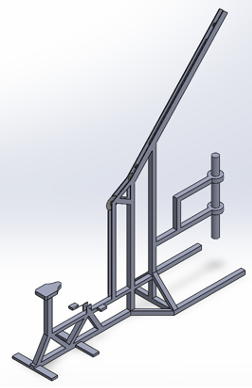
We prioritized retaining the existing frame while addressing drilling performance, transport, assembly, safety, and power input.
I evaluated ways to convert pedal rotation into drill motion. We compared worm-gear, bevel-gear, and pile-driver concepts and selected the lift-and-release architecture for the rocky conditions identified in the regional research.
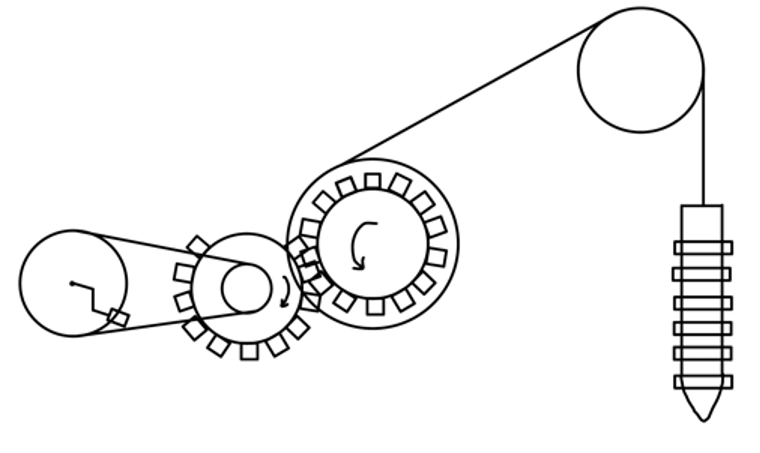
Pedal rotation passes through a chain and gear system to a cable pulley that lifts the drill. A toothless section of one gear disengages the drive so the drill can fall; re-engagement begins the next lift.
We packaged the pedal drive, gearbox, and cable mechanism around the retained frame. Controlled release and gear re-engagement are key interfaces to evaluate in a prototype.
Analysis & Validation
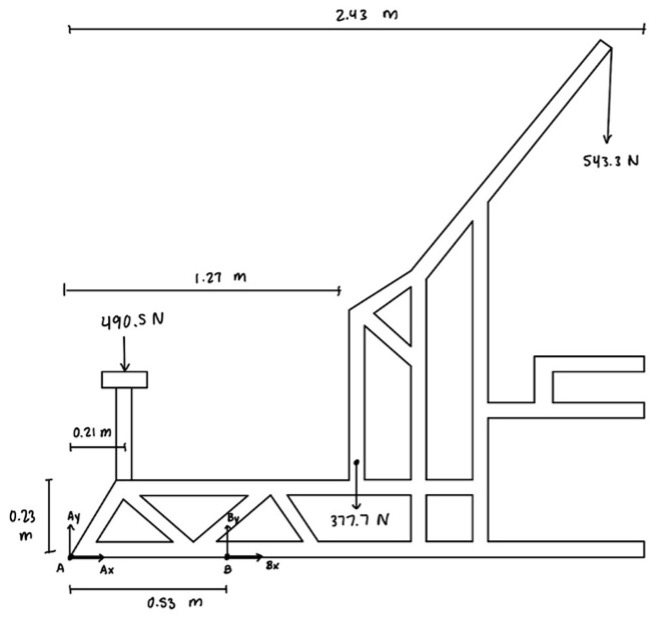
I worked backward from the modeled drill load and drivetrain geometry to estimate cable tension and pedal force, then calculated frame reactions and connection loads.
I used a factor of safety of 4 for the primary structural connection and 2 for the lower-risk pedal connection to calculate minimum pin sizes. These analytical minima would need to be translated into practical hardware sizes with allowances for bearing, wear, and repeated loading.
I also calculated the relationship between pedal speed, gearing, and drill motion to evaluate the assumed operating point. These estimates depend on the selected drill load, geometry, and operating assumptions.
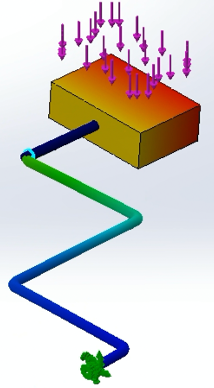
The team used FEA to estimate pedal stress and deformation under the calculated load. This static loading assessment did not address the mechanism’s repeated impact or engagement behavior.
Results
We completed a pedal-powered lift-and-release concept with CAD, drivetrain calculations, connection sizing, and pedal FEA. The analysis supported further development under the modeled conditions.
A physical prototype would be needed to evaluate drivetrain losses, release and re-engagement, impact durability, and drilling performance before establishing practical feasibility.