(06)
Well Driller
Developing a conceptual design of a well driller that relies on human-produced pedal power.
I worked with a team to develop a modification to the Village Drill that replaces conventional power input with human-generated pedal power. The goal was to create a mechanically feasible drilling system that could be operated through sustained pedaling while meeting the structural and power requirements of the drilling process.
Our design process required us to balance mechanism complexity, mechanical advantage, structural loading, power transmission, and the physical capabilities of the user.
Concept Development
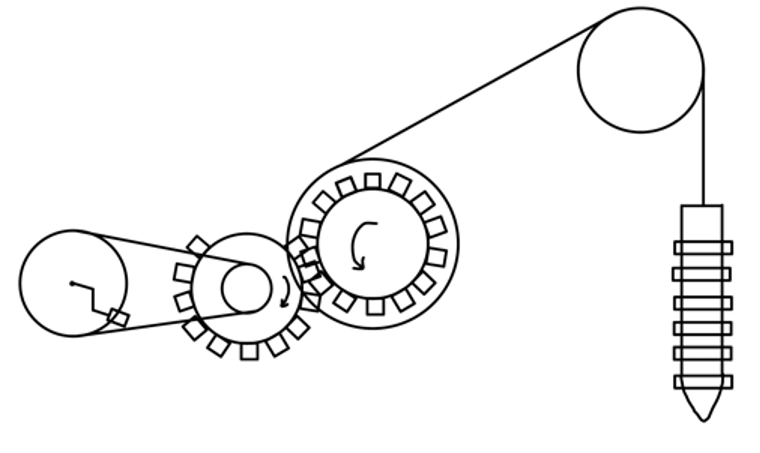
We explored several mechanisms for converting the rotational motion of the pedals into the vertical motion required to drive the drill. Concepts included bevel gears, worm gears, and a pile-driver mechanism.
After evaluating the concepts against stakeholder requirements and system-level constraints, we selected a pile-driver architecture. Rather than continuously driving the drill downward, the mechanism uses pedal input to lift the drill and then releases it, allowing the drill to fall under its own weight.
Engineering Analysis
We developed the system geometry in SolidWorks and used the resulting model to evaluate the mechanical relationships between the pedal input, cable system, lifting mechanism, and drill assembly.
The design was sized around the forces and motion required to repeatedly lift the drill while keeping the required pedal force within a practical range for the operator.
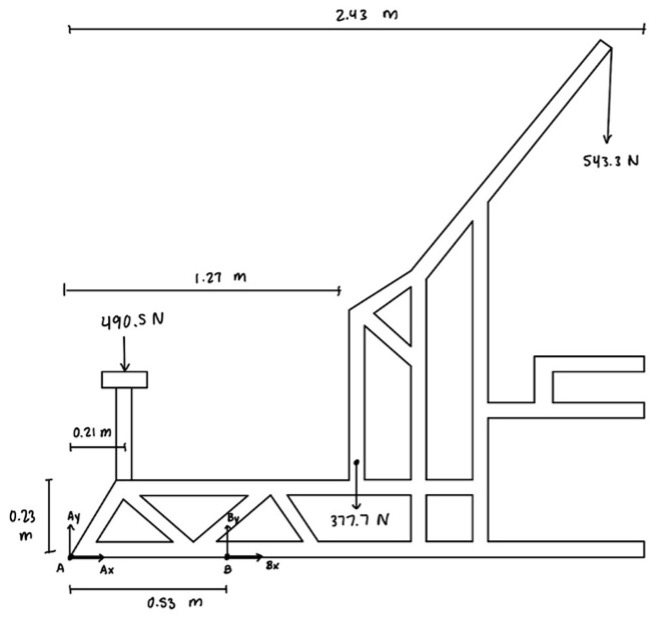
We performed static force analysis to determine cable tension, pedal force, and reaction forces at the structural mounting points. These loads were then used to determine the minimum required pin diameters based on the target factor of safety.
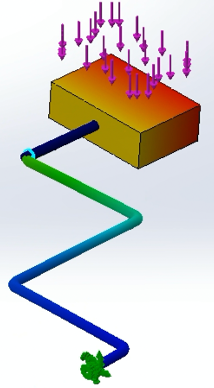
We also evaluated the structural integrity of the pedal using Finite Element Analysis (FEA), identifying regions of higher stress and verifying that the proposed geometry could withstand the expected loading.
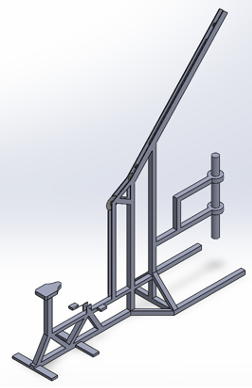
Finally, we calculated the mechanical power required to operate the drilling mechanism. This allowed us to determine the approximate pedal rotation rate needed to achieve the required drilling cycle and assess whether the system was practical for human operation.
Results
Our analysis indicated that the proposed design was mechanically feasible and could satisfy the identified structural and power requirements.
This project allowed me to apply statics, stress analysis, dynamics, and power transmission to a system-level mechanical design. It also reinforced the importance of evaluating a mechanism not only for whether it works mechanically, but also for whether its force and power requirements are practical for the intended user.