(02)
Trash Compactor
Designing and fabricating an automated household trash compactor to reduce waste volume and plastic bag consumption.
Overview
Residential trash compactors are often expensive built-in appliances that require permanent installation, while lower-cost alternatives rely on manual compression and significant user effort. Our goal was to develop a compact, standalone trash compactor that automatically compresses household waste while remaining affordable, easy to use, and suitable for manufacturing at a consumer price point.
Over the course of a semester, my team designed, analyzed, fabricated, and tested a fully functional prototype within an $800 budget. The project ended with a live demonstration at the Carnegie Mellon Mechanical Engineering Design Expo, where it received the Best Overall Project award.
Concept Development
We began by benchmarking commercially available trash compactors to understand existing solutions and identify opportunities for improvement. Many products were either very expensive, required permanent installation, or depended on manual user force to compress waste. From this research, we established the primary design objectives:
- Reduce household trash volume with minimal user effort
- Fit within the footprint of a standard kitchen trash bin
- Operate safely with a simple user interface
- Minimize manufacturing complexity and cost
After brainstorming multiple concepts, we evaluated each using weighted design criteria including performance, manufacturability, durability, ease of use, and cost. The final concept combined a scissor-lift mechanism with a linear actuator, providing a compact package while generating sufficient mechanical advantage to compress typical household waste.
Throughout the design process, we considered Design for Manufacturing and Assembly (DFMA), Failure Mode and Effects Analysis (FMEA), and Design for Environment (DFE) principles to guide design decisions.
Mechanical Design
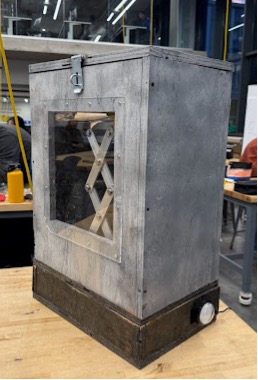
The final prototype integrates a motorized compaction system inside a wooden trash bin and requires no user assembly. When activated, a linear actuator drives a scissor-lift linkage that raises a compression plate against the underside of the lid, compacting the trash. The controller maintains the compression force for approximately ten seconds before automatically retracting the mechanism.
An enclosure beneath the bin houses the actuator, stepper motor, and Arduino-based control system, while a latching mechanism secures the lid throughout the compression cycle to ensure safe operation.
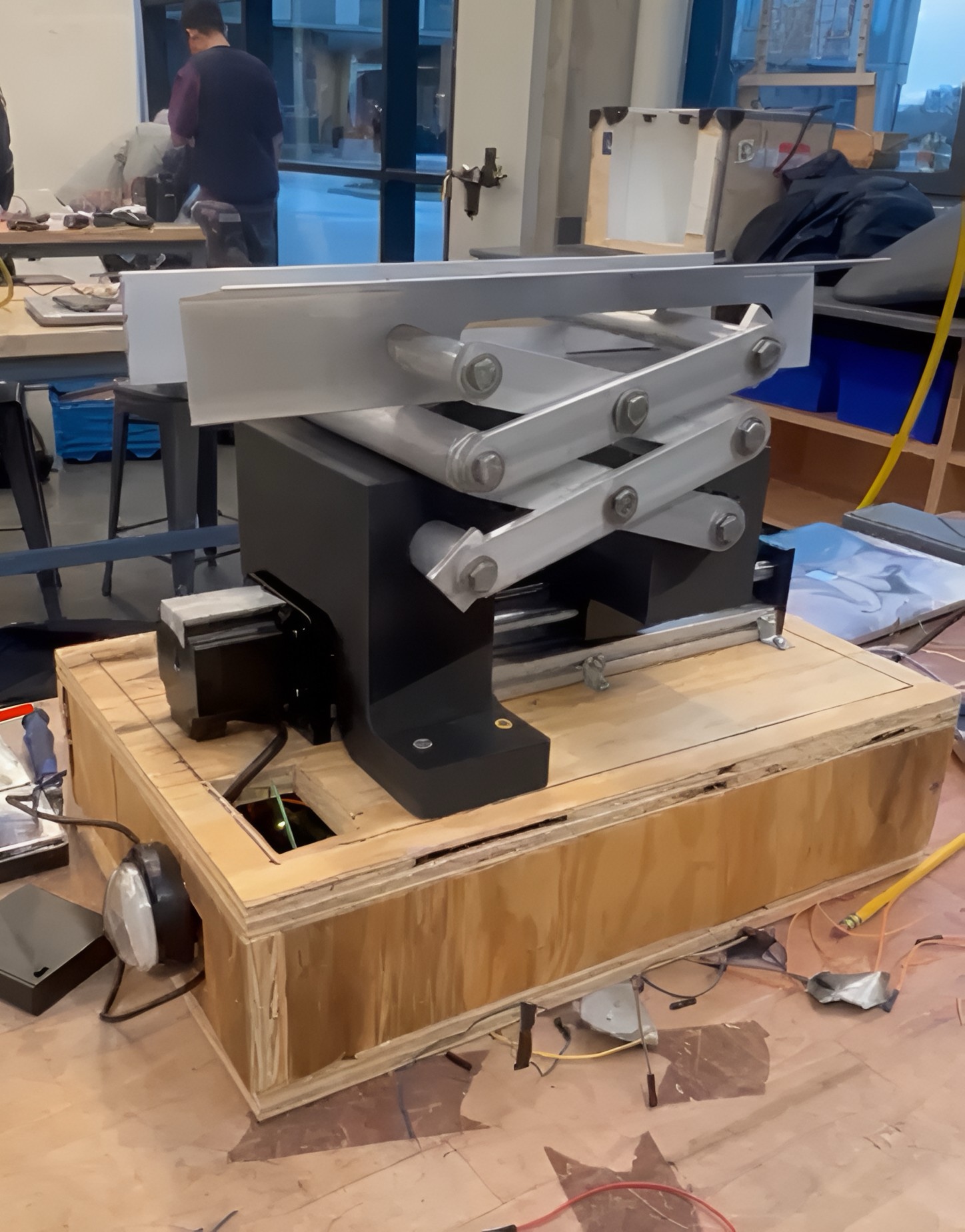
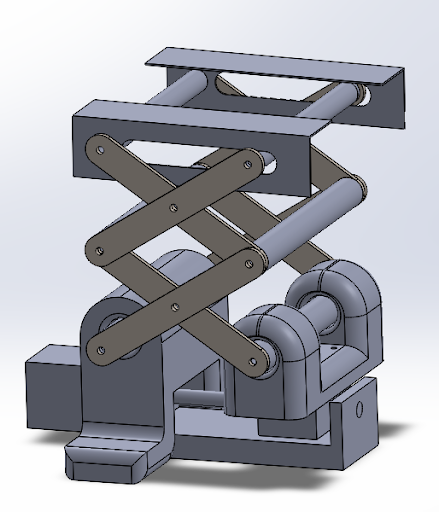
The linkage assembly was fabricated from machined aluminum bars and rods. We manufactured the links and L-brackets using manual milling and turning operations, then designed custom actuator interfaces in SolidWorks and produced them with additive manufacturing for rapid iteration. The wooden enclosure was cut, assembled, and integrated with the mechanical system, electronics, hinges, and locking hardware to create a fully functional prototype.
Although the prototype emphasized rapid fabrication and testing, we also considered how the design would transition to mass production through alternative materials and manufacturing processes.
Engineering Analysis
Before fabrication, we developed CAD models and performed engineering calculations to size the linkage system and verify that the selected actuator could generate sufficient compaction force.
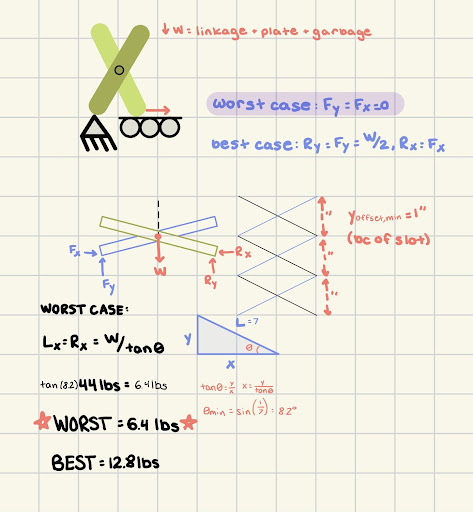
Using free-body diagrams and static force analysis, we evaluated the load transmitted through the linkage under both worst-case and best-case loading conditions. These calculations predicted that the mechanism could support approximately 6.4 to 12.8 lb before the actuator stalled, depending on the distribution of reaction forces.
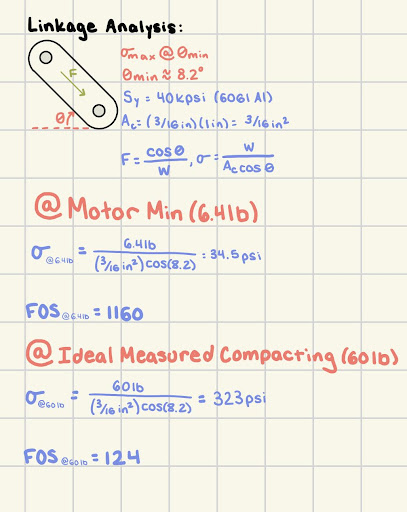
We also evaluated the structural capacity of the linkage members through factor-of-safety calculations. The analysis showed that the aluminum linkage had significantly greater strength than required for expected operating loads, indicating that actuator capacity, not structural failure, would ultimately limit system performance.
Physical testing confirmed this prediction. During testing, the linkage remained well within its structural limits while the actuator became the limiting component when compressing heavier loads. Based on these results, we identified a higher-capacity actuator as the primary improvement for a production-ready design.
Results
The completed prototype successfully demonstrated automated household waste compaction using a fully integrated mechanical and electrical system. The project was recognized with the Best Overall Project Award at the 2025 Carnegie Mellon Mechanical Engineering Design Expo.
This project strengthened my experience in product design, mechanism design, CAD, engineering analysis, fabrication, and mechatronic system integration. It provided experience taking a product from early concept generation through prototyping, testing, and iterative refinement.